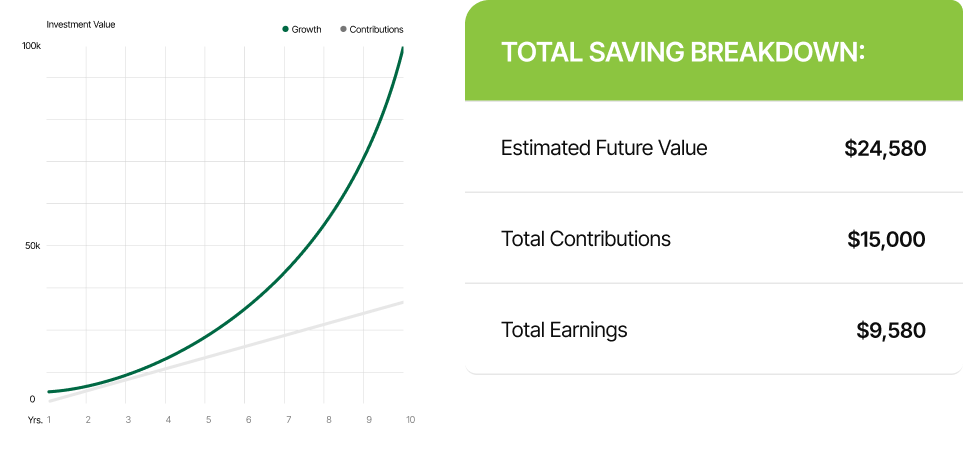
Start by entering the amount you already have ready to invest. Add how much you plan to contribute every month, even if it is zero. Set your expected annual return, your time period in years, and how often your money compounds. These five numbers are all this tool needs.
The results panel splits your projected balance into two parts you can compare side by side. One number shows the money you put in yourself, and the other shows what growth added on top. Watch how the growth portion grows relative to your contributions as the time period extends.
What Each Input Means
Starting Amount: The money you already have ready to invest today.
Monthly Contribution: The amount you plan to add every month, if any.
Expected Annual Return: The yearly growth rate you expect your money to earn.
Time Period: The number of years you plan to leave the money invested.
Compounding Frequency: How often your earnings get added back to your balance.
How to Use This Calculator
The estimated future balance shows what your money could reach if your assumptions hold steady the whole time. It combines every dollar you contribute with every dollar of growth compounding adds on top. Treat it as a planning estimate, not a promise about your actual account balance.
Small changes to your return, time period, or monthly contribution move the final number more than expected. A longer time period rewards patience because compounding needs years to build momentum. Even a modest increase in your monthly contribution compounds alongside everything else. Compounding frequency plays a smaller role, but it still adds up over decades.
What Changes Your Number
A higher expected return grows your balance faster, but real returns move up and down every year.
A longer time period gives compounding more years to work, even with the same contribution.
A larger or more frequent monthly contribution adds directly to your total, on top of growth.
More frequent compounding, such as monthly instead of annually, produces a slightly higher balance.
Derick Do is a business investor who writes about investing fundamentals for beginners at Profitforge Advisors. He focuses on breaking down growth concepts like compounding into clear, practical steps for new investors and savers.
Related Tools
Not Found
Practical strategies and honest analysis from our expert team
How to Create a Budget That Actually Works
You have probably tried this before. An app, a spreadsheet, a notebook from the drugstore. It worke...